In ihrer Buchbinderei reiht sich jeder Tag wie ein Einband in den naechsten.
The story
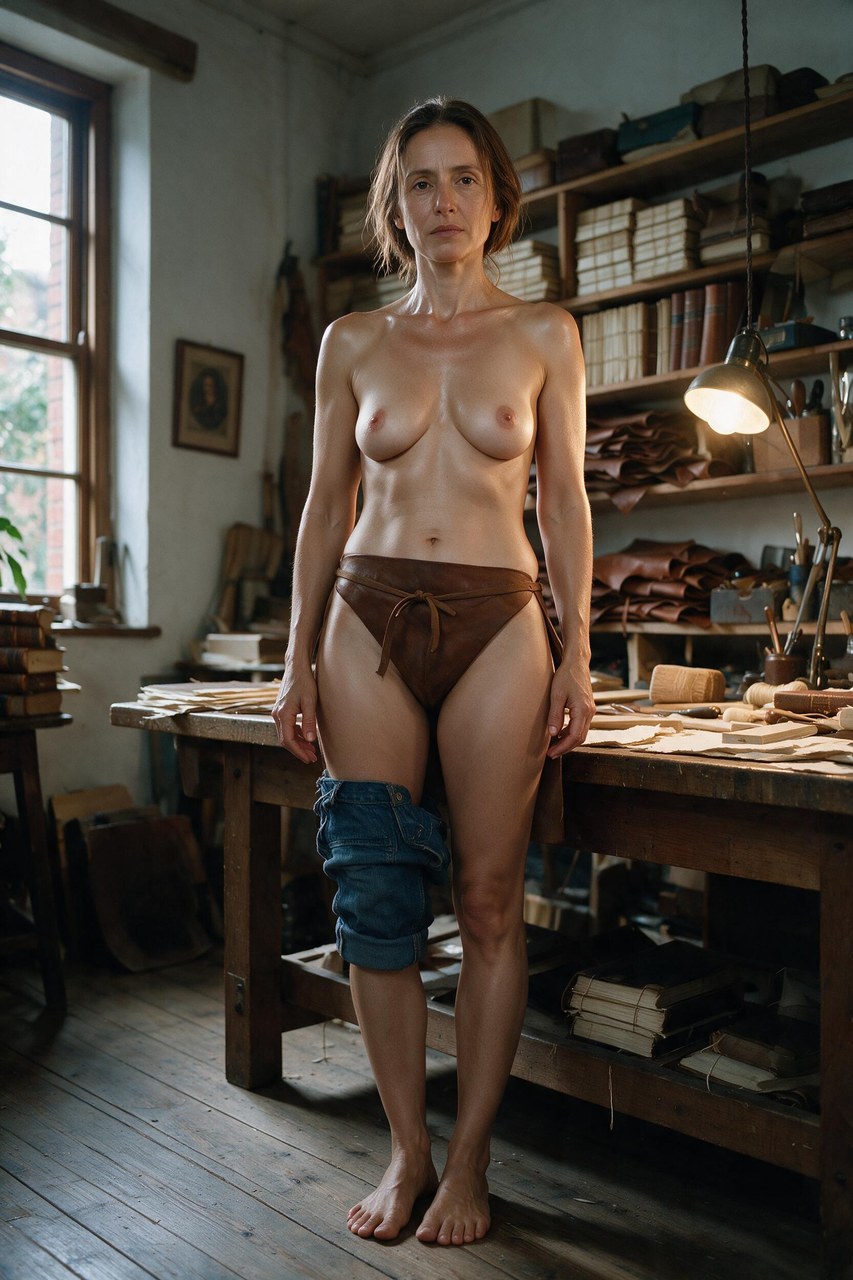
The old wood of the bench is smooth from years of use. Rocío strokes the back of her hand over the edge, feeling the indentations of the glue. The lamp falls diagonally over her shoulder, illuminating the grain of the leather still bound around her hips. With her free hand she straightens a loose strand that has broken free from the knot, tucking it behind her ear. A stack of half‑finished book bindings leans against her back, their covers still awaiting embossing. She takes a deep breath: the air smells of paper dust and warm metal.
The setting
The workshop sits on the ground floor of a corner house, its windows looking out onto a quiet side street. Between the tall glass panes and the dark wooden shelves dust hovers in the light that falls from the left.
Who she is
Die Buchbinderin
Rocio has operated a small bookbinding studio in the ground floor of an old corner building for fifteen years. There, she repairs ancient folios and binds new manuscripts in leather. When she asked you after the last commission if you would like to photograph her at work, she simply replied that the light is most beautiful in the morning.
Her world
Rocio stacks the folded signatures on the wide wooden bench in the morning before sewing them into a block, just as traditional bookbindery teaches hand sewing signatures as the first step.[1][6][13]
When you watch her bind the signatures with linen thread onto ribbons, you notice techniques that many courses regard as the core of classic hand bookbinding.[1][4][12]
The thick leather skins she selects for bindings recall master classes where full‑leather bindings with rounds and spine shapes, as well as headband work, are taught.[1][10]
A short glossary
Signature
Several folded layers of paper sewn into a section of a book block, the core step in traditional bookbinding workshops.[1][6][13]
Full‑leather binding
Binding in which the cover and spine are fully covered with leather, often taught in master classes of historic bookbinding.[1][10]
Rounds and spine shapes
Techniques that shape the spine from a flat block into a gentle curve so the book opens more elegantly.[1][10]
Headband
Narrow, usually colored trim at the top and bottom of the spine, sewn in advanced courses as a decorative and stabilizing detail.[1][10]